
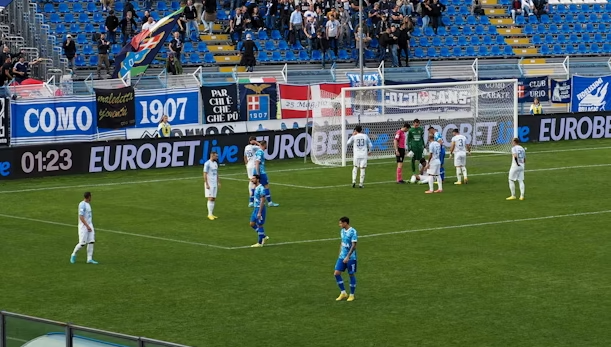
As of December 20, 2025, Frosinone Calcio leads the Italy Serie B standings with 37 points from 17 matches, sitting comfortably at the top of the league with an impressive goal difference of +18. The Ciociaria club has won 11 matches with only 2 losses, demonstrating exceptional form and consistency throughout the first half of the season. The Serie B remains one of Europe’s most competitive second divisions, featuring 20 teams fighting for three promotion places to Serie A and battling against relegation to the third tier. Understanding the current standings, promotion mechanics, and relegation battle provides essential context for football enthusiasts, bettors, and analysts tracking Italy’s secondary league.
Understanding Serie B League Structure
Serie B operates as Italy’s second-tier professional football league, positioned directly below Serie A in the national football pyramid. The league consists of 20 teams that compete in a double round-robin format, meaning each team plays every other team twice—once at home and once away—for a total of 38 matches per season. The championship runs from August through May, with teams accumulating three points for a win, one point for a draw, and zero points for a loss. The point total, combined with goal difference and goals scored, determines final league positions and determines promotion and relegation outcomes.
The league’s competitive nature has earned it a reputation as one of the most unpredictable and exciting divisions in European football. Teams with historical prestige compete alongside ambitious clubs seeking immediate return to the top flight. Several clubs relegated from Serie A in previous seasons are actively seeking redemption, while other teams are motivated by promotion aspirations. This creates compelling narratives throughout the season, with dramatic shifts in standings occurring regularly, especially during the crucial final months.
Current Top Teams and Leaders
Frosinone Calcio currently occupies the summit with their dominant performance, accumulating 37 points through 17 matches played. The Ciociaria outfit has demonstrated impressive attacking prowess with 33 goals scored while maintaining defensive solidity with only 15 goals conceded. Their goal difference of +18 represents the strongest attacking record relative to defensive performance in the league, indicating a balanced approach to football that has yielded consistent results. Frosinone’s 11 victories, 4 draws, and only 2 defeats showcase their ability to earn points across various match situations.
Monza, the second-placed team, trails Frosinone by 3 points with a total of 34 points from identical matches played. The Brianza club has recorded 10 wins, 4 draws, and 3 losses, demonstrating nearly comparable consistency to the league leaders. Monza’s goal difference of +12, combined with their points total, positions them as strong contenders for automatic promotion. The third-promotion spot remains the subject of intense competition, with multiple teams separated by narrow point margins.
Venezia occupies third place with 32 points, secured through 9 wins, 5 draws, and 3 losses across 17 matches. The Venetian club boasts an impressive goal difference of +16, highlighting their efficient goal-scoring capabilities. Cesena sits in fourth position with 31 points from 9 wins, 4 draws, and 4 losses. These positions place them within the playoff qualification zone, though the top three positions command automatic promotion to Serie A. Palermo and Modena round out the top six with 30 and 29 points respectively, maintaining ambitions for automatic promotion while simultaneously securing playoff positions should they fail to catch the leaders.
Serie B Promotion Pathway Explained
Serie B employs a unique three-tier promotion system that combines automatic promotion with playoff competition. The two highest-finishing teams at season’s conclusion earn automatic direct promotion to Serie A, guaranteeing their place in the top flight without requiring additional playoff matches. This provides strong incentive for teams to maintain high league positions throughout the entire season, as automatic promotion represents a significant advantage over potential playoff opponents.
The third promotion spot is determined through a competitive playoff tournament involving teams that finish between 3rd and 8th place in the regular season standings. However, an important exception exists: if the third-placed team finishes more than 14 points ahead of the fourth-placed team, the third-place team automatically receives promotion to Serie A without participating in the playoffs. This mechanism, which has occurred only once in Serie B history during the 2006-07 season, effectively eliminates the playoff competition if a clear separation emerges between top contenders.
For the 2025-26 season, teams finishing 3rd through 8th qualify for playoff participation, where they compete in preliminary round matches, followed by semifinals and finals. The structure ensures that multiple pathways exist for promotion, rewarding both regular season consistency and playoff performance. This system creates dramatic narratives as teams fight for positioning throughout the season, with late-season matches often determining playoff seeding and matchups.
Playoff Contenders and Competitive Midfield
Beyond the automatic promotion leaders, teams occupying positions 3-8 remain locked in intense competition for playoff qualification. Catanzaro currently holds 7th place with 28 points from 7 wins, 7 draws, and 3 losses. The Calabrian club’s balanced approach has generated competitive results, though they remain 9 points behind Frosinone. Juve Stabia maintains 8th place with 23 points, their position secured through consistent drawing rather than emphatic victories. The Campania club has recorded 5 wins and 8 draws, suggesting a defensive approach that prioritizes avoiding losses.
The playoff zone appears relatively secure for the top eight teams, as the fifth-placed Palermo leads the second tier of clubs, while teams outside the eighth position face significant points deficits. Padova in ninth place and Avellino in tenth position remain just outside playoff qualification, with realistic opportunities to surge back into contention should they maintain strong form through remaining matches. The competitive nature of these middle-table positions ensures unpredictable outcomes and maintains fan engagement throughout the season.
Relegation Battle and Bottom Teams
At the opposite end of the standings, three teams face automatic relegation to Serie C, the third tier of Italian football. The current bottom three positions are occupied by Spezia, Mantova, and Pescara, each possessing severe challenges to escape relegation mathematics. Pescara, positioned at 20th place, has accumulated only 13 points from 2 wins, 7 draws, and 8 losses across 17 matches. Their goal difference of -11 reflects significant defensive vulnerability, with 33 goals conceded against only 22 scored.
Between the automatic relegation positions and playoff qualification exists the playoff relegation zone, where teams ranked 16th and 17th compete in a playoff match to determine which team joins the automatic relegation candidates in Serie C. Currently, Virtus Entella and Sampdoria occupy these precarious positions with 15 and 14 points respectively. Sampdoria’s recent struggles represent a dramatic fall for a historically prestigious club, which competed in Serie A only three seasons prior. The Italian club’s relegation battle exemplifies the competitive nature of Serie B and the velocity with which clubs can rise or fall through the football pyramid.
Key Players and Scoring Leaders
Joel Pohjanpalo of Palermo has emerged as the league’s leading goal scorer with 10 goals from 17 matches, demonstrating exceptional finishing ability and positioning. The Finland international has provided crucial attacking contribution to Palermo’s promotion push. Close behind Pohjanpalo, Massimo Coda of Sampdoria and Ettore Gliozzi of Modena have each netted 7 goals, maintaining goal-scoring prowess despite their respective teams’ varying positions in the table.
Andrea Adorante of Venezia has scored 6 goals, contributing to Venezia’s third-place finish through consistent attacking contribution. Similarly, Mattia Bortolussi of Padova and Stiven Shpendi of Empoli have each registered 6 goals, showcasing emerging talent within the division. These goal scorers represent the dynamic attacking quality throughout Serie B, with multiple teams possessing credible scoring threats rather than being reliant on individual players.
Defensive Performance and Goalkeeper Excellence
Defensive stability determines league standings as critically as attacking prowess, with Frosinone’s goalkeeping dominated by Lorenzo Palmisani, who has recorded 7 clean sheets from 17 matches. This defensive consistency contributes significantly to Frosinone’s league-leading position. Similarly, Filip Stanković of Venezia and Demba Thiam of Monza have each achieved 7 clean sheets, positioning their respective teams as defensive powerhouses within the division.
The clean sheet statistics reveal that Frosinone, Venezia, and Monza represent the three defensively strongest teams, with each maintaining superior goal prevention compared to competitors. This defensive solidity, combined with adequate attacking capability, has enabled these clubs to accumulate substantial points. In contrast, teams struggling to generate clean sheets—such as Bari with limited defensive security—face greater challenges in accumulating points despite potential attacking ability.
Historical Context and Performance Benchmarks
Serie B has undergone continuous evolution since its establishment in 1929 as the second tier of Italian professional football. The league has historically served as a proving ground for emerging talent, with numerous future Serie A stars beginning their careers in Serie B competition. The league’s format has changed numerous times, transitioning from regional divisions to unified national competitions, reflecting broader developments within Italian football structure and administration.
The current 20-team, double round-robin format has remained relatively stable for several decades, ensuring competitive consistency across seasons. Teams promoted from Serie B to Serie A in recent seasons have demonstrated variable success, with some immediately contending for Serie A honors while others struggle with the increased competitive intensity. The 2025-26 season continues this tradition of providing pathways for ambitious clubs and talented players to pursue elite-level football opportunities.
Practical Information and Viewing Guide
How to Watch Serie B Matches
Destination Calcio continues providing free-to-watch coverage of Serie B matches in the UK, Ireland, the United States, and approximately 50 additional countries worldwide. Live matches, complete replays, and highlighted packages are accessible via the Destination Calcio television website and dedicated mobile applications available through Google Play and Apple’s App Store. The platform broadcasts three live matches every weekend throughout the season, alongside comprehensive highlight coverage of remaining fixtures.
LaB Channel, the official Serie B streaming service, has launched on OneFootball with global availability including Italy. A seasonal pass costs €69.99 until September 15th, subsequently increasing to €89.99 for remaining season access. OneFootball provides LaB Channel content across connected television devices, mobile applications, and web browsers, offering comprehensive match coverage and post-match analysis. The platform features every Serie BKT live match alongside official highlights without regional restrictions.
Attendance and Stadium Capacity
Series B clubs maintain diverse stadium capacities reflecting their histories and resources. The 2024-25 season recorded average attendance of 9,577 spectators per match across all Serie B fixtures, demonstrating sustained fan interest in Italian second-tier football. Salernitana led attendance figures with 11,015 average spectators per home match, followed by Catanzaro with 10,228 and Cosenza with 10,178 average attendance. These attendance figures reflect the passionate fan bases supporting Serie B clubs despite their secondary league status.
Smaller stadiums characterize newly promoted clubs and geographically isolated teams, with capacities ranging from approximately 5,500 to 19,550 spectators. Some clubs have invested in stadium improvements to enhance capacity and infrastructure, reflecting ambitions for Serie A football and improved revenues. The diversity of stadium characteristics contributes to varied atmospheres throughout the season, with some venues generating intimidating home-field advantages while others feature intimate settings conducive to attacking football.
Seasonal Context and Match Dynamics
The 2025-26 Serie B season commenced in August 2025 and continues through May 2026, with matches contested throughout autumn, winter, and spring months. Weather conditions throughout the season affect playing styles, with winter months occasionally presenting challenging pitches and weather conditions. The season’s timing ensures alignment with European football calendars, allowing for coordination with international fixture schedules and player availability.
Early-season matches have established clear competitive patterns, with top teams demonstrating consistency while mid-table clubs struggle for sustained form. The first 17 rounds of matches have provided sufficient data to identify potential promotion and relegation candidates, though the campaign’s latter stages will likely produce dramatic shifts in standings. Historical precedent suggests that final matches frequently determine crucial outcomes, with teams fighting for survival or promotion glory in dramatic fashion.
Top Teams’ Tactical Approaches
Frosinone’s success has stemmed from balanced tactical approach, maintaining defensive solidity while generating sufficient attacking threat. The club’s relatively equal distribution of wins and draws suggests consistency rather than explosive form, indicating sustainable performance patterns. This approach maximizes point accumulation through minimized losses rather than pursuing ambitious attacking strategies with increased defensive vulnerability.
Monza has similarly achieved promotion credentials through tactical balance, prioritizing defensive organization while maintaining penetrative attacking phases. The consistent performance patterns evident in their league position suggest methodical approaches rather than volatile results. Conversely, Catanzaro’s 7 draws from 17 matches indicate a tendency toward defensive approaches, suggesting they prioritize avoiding defeats even when attacking opportunities emerge.
Venezia’s superior goal difference relative to rivals suggests more aggressive attacking approaches, with their 30 goals scored demonstrating offensive intent. This attacking philosophy generates opportunities for matches with higher scoring totals, potentially increasing points variability. The tactical diversity evident across different teams reflects varied managerial philosophies and squad compositions, contributing to Serie B’s competitive unpredictability.
Predicted Outcomes and Playoff Scenarios
Most analytical predictions favor Frosinone, Monza, and either Venezia or Cesena for automatic promotion to Serie A, based on current form and remaining fixture schedules. However, the league’s competitive nature ensures that unexpected results frequently upset prognostications. Should current trends persist through the season’s remainder, playoff competition will involve multiple teams capable of performing at elite levels, generating intense competition for the third promotion position.
Regarding relegation, Pescara faces severe challenges to escape automatic demotion, possessing only 13 points with approximately 21 matches remaining. Mathematical possibilities for survival exist, yet require exceptional performance improvements. Spezia and Mantova similarly face significant obstacles, though their superior point totals compared to Pescara provide marginally better relegation-escape scenarios. The eventual playoff play-out between 16th and 17th positions may determine crucial outcomes regarding which club joins the automatic relegation candidates.
Player Market Dynamics and January Transfers
January transfer windows typically witness significant activity within Serie B, with promoted clubs sometimes investing additional capital to strengthen squads for promotion pushes. Conversely, struggling clubs may sell their most valuable players to generate revenue and reduce financial burdens. Star performers like Joel Pohjanpalo attract transfer interest from higher-level competitions, potentially disrupting team balance should departures occur during critical seasons phases.
The division’s financial constraints compared to Serie A result in transfers dominated by loan agreements and budget-restricted signings rather than premium acquisitions. This creates situations where temporarily advantageous transfers may significantly impact competitive balance, with departures of key players potentially devastating team performance. Teams successfully managing transfer windows while maintaining squad cohesion typically outperform competitors struggling with disrupted rosters.
Competitive Analysis and Match Scheduling
The 2025-26 season features 380 total matches across 38 rounds of competition, with teams playing each opponent twice. Scheduling creates significant variance in fixture difficulty and timing, with some teams facing congested schedules against multiple top-six teams within short periods while others encounter more distributed challenging fixtures. Home advantage remains statistically significant throughout Serie B, with teams traditionally performing stronger within familiar stadiums.
The fixture list’s construction creates playoff qualification scenarios where late-season form becomes increasingly critical. Teams beginning the season poorly frequently demonstrate recovery potential throughout the season, while early leaders sometimes encounter sustained form deterioration. The extended season duration ensures that early-season predictions become increasingly unreliable as additional matches provide expanded data regarding team capabilities and consistency patterns.
Frequently Asked Questions
What does automatic promotion in Serie B mean?
Automatic promotion refers to the two highest-finishing teams at season’s conclusion directly advancing to Serie A without additional playoff competition. Frosinone and Monza currently occupy these positions, though final season standings determine definitively which teams secure automatic advancement. This system rewards consistent performance throughout the entire 38-match season.
How do playoffs work in Series B for the third promotion spot?
The third promotion position is determined through playoff competition involving teams finishing between 3rd and 8th place in the regular season standings. These teams compete in preliminary rounds, semifinals, and finals, with the champion earning automatic promotion to Serie A. However, if the 3rd-placed team exceeds a 14-point margin ahead of 4th place, they automatically receive promotion without playoff participation.
Which teams are currently relegated from Serie B?
Pescara, Spezia, and Mantova occupy the bottom three positions facing automatic relegation to Serie C should they finish in these positions at season’s conclusion. Additionally, the 16th and 17th-placed teams compete in a playoff play-out to determine which club joins the automatically relegated teams. Currently, Sampdoria and Virtus Entella occupy these precarious playoff relegation positions.
Can relegated teams return to Serie B immediately?
Relegated teams from Serie B drop to Serie C, requiring success within that competition to return. Some clubs subsequently secure immediate promotion back to Serie B within one season, while others require multiple seasons to regain elevation. Serie C’s greater geographic decentralization and competitive variety creates different obstacles compared to unified Serie B structure.
Who is the current leading goal scorer in Serie B?
Joel Pohjanpalo of Palermo leads Serie B goal-scoring with 10 goals across 17 matches played. The Finnish striker has demonstrated consistent finishing ability and positioning prowess, contributing significantly to Palermo’s third-position standing. Goal-scoring consistency throughout the season rather than explosive scoring runs characterizes Pohjanpalo’s performance.
How many matches has each team played currently?
Most Serie B teams have completed 17 matches from their 38-match season, representing approximately 45% of the campaign. Empoli and Südtirol have completed 16 matches while others have played 17, with slight variation due to rescheduled fixtures. Teams will complete their seasons through May 2026 after continuing fixture schedules.
What is the significance of goal difference in Serie B?
Goal difference determines league positioning when multiple teams possess identical points, with positive goal differences indicating superior goal-scoring relative to concession rates. Frosinone’s +18 goal difference reflects superior attacking efficiency and defensive organization compared to direct competitors. Goal difference frequently determines crucial playoff qualification and relegation outcomes in tightly contested standings.
Can Series B clubs receive deductions for administrative violations?
Yes, Serie B clubs can receive points deductions for administrative violations, match-fixing involvement, or financial irregularities. Recently, Brescia received a four-point deduction for administrative violations, significantly impacting their relegation position. These deductions can determine league position changes and affect playoff or relegation outcomes substantially.
How does weather impact Serie B matches throughout seasons?
Winter conditions in Italy create wet and muddy playing surfaces that reduce passing accuracy and increase injury risk compared to autumn months. These conditions often favor defensive approaches and reduce goal-scoring frequency. Spring months typically feature improved weather conditions facilitating more technical football and higher-scoring matches.
Are international break matches scheduled within Serie B season?
Yes, Serie B schedules accommodate international fixtures when national teams compete in World Cup qualifiers, European championships, or friendly matches. These breaks can extend fixture schedules and create fixture congestion as teams complete remaining matches. Some teams benefit from international breaks through injury recovery while others experience disruptions to match momentum.
What streaming services broadcast Serie B in North America?
Destination Calcio continues providing free-to-watch Serie B coverage in the United States without subscription requirements. LaB Channel also operates through OneFootball’s platform, offering comprehensive coverage with season passes. These services ensure North American football enthusiasts maintain access to Serie B matches throughout the season.
Do Serie B clubs compete in European competitions?
Directly, no. Only Serie A clubs are eligible for UEFA European competition entry through league position achievement. However, Coppa Italia allows some Serie B teams to participate, providing European-style knockout competition opportunities. Promotion to Serie A provides subsequent seasons’ European competition eligibility for successful teams.
How are Serie B matches officials selected and trained?
Italian football’s federative body (FIGC) employs comprehensive officiating selection systems to ensure qualified referees and assistant referees manage Serie B matches. Referee training programs emphasize consistent decision-making and proper interpretation of complex rule applications. Performance evaluations determine referee advancement toward Serie A positions and continued Serie B appointment.
What is the historical significance of Serie B within Italian football?
Serie B has produced numerous future Serie A and international football stars throughout its existence since 1929. The division provides pathways for ambitious clubs and emerging talent to demonstrate capabilities at elite levels. Many Serie A clubs experienced Series B promotion, with some returning to the division following Serie A relegation, creating compelling narratives.
Can suspended players from Serie A compete in Serie B?
Generally, players suspended from Serie A competition due to disciplinary issues cannot compete in Serie B matches concurrent with their suspensions, as suspensions apply throughout Italian football structures. However, specific circumstances determine whether suspensions restrict only Serie A or extend throughout professional competitions, typically depending on suspension cause.



Leave a Reply