
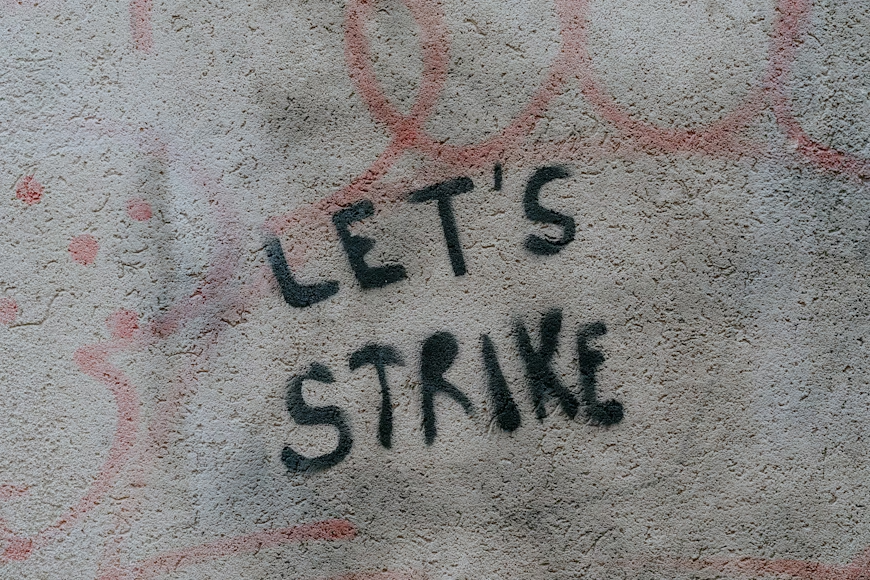
London has once again been gripped by widespread Tube strikes, paralysing the capital’s vital transport network and sending shockwaves through daily commuters, local businesses, and the city’s economy. With millions of journeys disrupted over several days, the recent strikes—led by the powerful Rail, Maritime and Transport (RMT) union—reflect longstanding frustrations over pay, working conditions, and labour rights.
This article unpacks the most recent Tube strike action, exploring its causes, impacts, official responses, and what Londoners can expect going forward. It also examines how these events fit into the broader context of labour relations in the UK’s capital city.
What Is the Tube Strike and Who’s Involved?
The Tube strike involves thousands of workers on the London Underground who are members of the RMT union. This union represents a broad spectrum of staff, including drivers, station workers, and maintenance crews. The latest round of strikes stretched over five consecutive days, starting early September 2025.
The union orchestrated a rolling schedule of walkouts, protesting against pay disputes, fatigue from extreme shift patterns, and the demand for a shorter workweek—specifically a reduction from 35 hours to 32 hours. The Rail, Maritime and Transport union argues that management has failed to seriously engage with these demands, violating previous agreements and ignoring staff welfare.
Transport for London (TfL), the governing body responsible for running the Tube, responded by offering a 3.4 percent pay increase, which the union rejected as insufficient. TfL also labelled the demand for shorter hours as “impractical and absolutely unaffordable,” citing steep costs upwards of £200 million annually that would affect investment in the transport network.
The Impact on Commuters and the City
The London Underground is the artery of the city’s transport, supporting roughly 5 million passenger journeys each weekday across 11 lines and 272 stations. When the strikes hit, services across nearly all lines came to a halt. Only the Elizabeth line and London Overground offered limited alternatives.
For commuters, this meant major disruption. Many had to seek alternate routes, switch to buses, bikes, or even boats, or simply abandon travel plans altogether. The strikes not only hampered everyday journeys but also brought economic ripple effects.
Data analysed from the hospitality sector during the strike period revealed a staggering 67 percent drop in bookings across London venues. On the strike’s first day, bookings plummeted 62 percent overnight, with spontaneous walk-in visits falling almost 69 percent. Consequently, restaurants, bars, and entertainment venues suffered sharp declines in revenue, compounded by a 50 percent surge in cancellations.
The total estimated economic cost of the strikes reached around £230 million, underscoring the wider fallout beyond just travel inconvenience.
Official Responses and Political Fallout
Mayor of London Sir Sadiq Khan faced significant criticism for his perceived lack of direct intervention during the strikes. As Chairman of TfL, many expected a stronger role in negotiating a resolution. Instead, his appearances in public debates were sparse, and he was accused of focusing on lighter topics rather than the transport crisis.
Public opinion was sharply divided. While many commuters expressed frustration at the lost productivity and chaos, supporters of the strike argued that the workers’ demands were justified given the critical role they play and the challenging conditions they face.
TfL repeatedly urged the RMT to suspend the strike and return to talks. The union welcomed further negotiations but insisted on meaningful progress on their core issues, primarily work hours and fatigue management.
Historical Context: Tube Strikes in London
London Underground strikes are not new, and their history is intertwined with the city’s political and economic shifts. Previous years have seen several rounds of industrial action over pay disputes, staffing levels, automation fears, and safety concerns.
The RMT has historically been prominent in calling strikes, often leading to significant disruption but also sometimes delivering concessions through collective pressure.
Government attempts to legislate tighter controls on strike actions have met with resistance from unions, underscoring the delicate balance between labour rights and public convenience.
What Next? Will There Be More Strikes?
As the most recent strike wave came to an end, questions remain about the likelihood of future industrial action.
The RMT union softened its demand to “steps towards” a 32-hour week, signalling a potential willingness to compromise. However, TfL has maintained that any reduction in work hours beyond a minor cut is financially unviable.
Politicians and transport officials are calling for renewed dialogue. Griffin Khan indicated expectations for meetings to resume between TfL and the RMT union soon, though the path to a lasting resolution remains uncertain.
For further strikes to occur, union members must vote in a ballot, requiring at least 14 days’ notice to TfL, though a shorter timeframe can be mutually agreed.
Meanwhile, many commuters and businesses hope for stability and improvements in London’s transport services following these turbulent weeks.
Navigating the Strike: Advice for Londoners
During strike periods, TfL has recommended several alternatives to Tube travel. Bus services continue though often suffer congestion. Cycling, walking, or using the Docklands Light Railway (DLR) can be practical for some journeys. Employers have been encouraged to offer flexible working arrangements or remote work options to reduce travel demand.
Transport updates via TfL’s official channels and news outlets are critical for planning daily trips. With services gradually returning to normal, patience remains key as London adjusts.
Expert Views on Labour Disputes and Urban Transit
Transport and labour experts highlight that the current situation reflects deeper structural challenges in urban transit systems.
Long hours and shift work contribute to staff fatigue, a safety and morale concern. Pay disputes arise amid tightening public budgets and expectations for affordable fares.
Finding balance requires negotiating fair compensation and working conditions while ensuring sustainable funding and service reliability.
Some analysts argue that without robust investment and modernisation, such industrial actions could recur, highlighting the need for government and city authorities’ active engagement.
Tube Strike: Summary
The recent London Tube strikes were sparked by unresolved disputes over pay, working hours, and fatigue management. The action severely disrupted travel for millions and inflicted economic harm, especially on hospitality businesses.
Efforts to resolve the conflict continue, though differences over key issues remain significant. While promises of talks offer hope, London faces ongoing uncertainty about its transport future.
For Londoners, staying informed, exploring travel alternatives, and supporting constructive dialogue between workers and management remain essential.
Frequently Asked Questions (FAQ)
Q1: Why are London Tube workers striking?
A1: The main issues are pay disputes, long and exhausting shift patterns, and a union demand to reduce the working week from 35 hours to 32 hours.
Q2: How long did the most recent Tube strike last?
A2: The latest strike lasted five days, from Sunday to Thursday, with services gradually resuming on Friday.
Q3: What has been the economic impact of the Tube strike?
A3: London’s economy, particularly hospitality, saw a 67 percent drop in bookings, with estimated costs for the city around £230 million.
Q4: What alternatives are available during Tube strikes?
A4: Commuters are encouraged to use buses, bikes, walk, or use the Elizabeth line, Overground, or Docklands Light Railway where possible.
Q5: Will there be future strikes on the London Underground?
A5: Future strikes depend on union ballots and negotiations, with a key sticking point being the demand for a shorter working week. Talks are ongoing.
For more UK focused stories and trending news, check these out:
- National Living Wage 2024 Updates on LondontimeNow
- BBC News for the latest UK news and events
- Official UK Government updates on transport and labour


Leave a Reply