
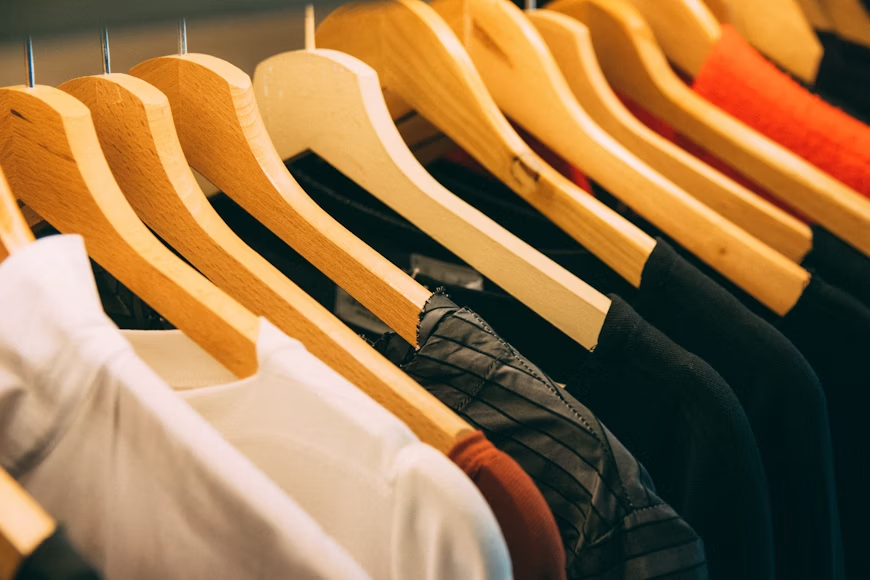
Marks & Spencer has just thrown open the doors to its boldest sustainability play yet, launching a groundbreaking second-hand clothing scheme that’s reshaping how British consumers think about getting dressed. The launch in August 2025 marks a watershed moment for the nation’s most iconic retailer, offering customers cold, hard cash incentives to offload their unwanted wardrobe whilst tackling one of Britain’s most pressing environmental problems.
The Game-Changing M&S Resale Platform Explained
From 26 August 2025, Marks & Spencer launched its first dedicated resale service in partnership with eBay, powered by garment experts Reskinned. The scheme is elegantly simple in design but profound in its implications. Customers can now send in pre-loved M&S clothing, footwear, and accessories to Reskinned through a free courier collection service.
Here’s how it works in practice. Fill out a quick form on the M&S website or scan a QR code in your local store. Pop your unwanted items into any box you have lying around (M&S specifically encourages reusing packaging to minimise waste). Pop it in the post using the free courier service arranged by Reskinned. Within weeks, you’ll receive a digital voucher delivering £5 off your next purchase of £35 or more on fashion, home, and beauty items online.
The beauty of this model lies in its transparency. Every item sent back undergoes professional inspection. Top-quality pieces get carefully cleaned using Reskinned’s innovative water-free ozone cleansing technology and repaired if needed, then listed on the official M&S x eBay Official Store for someone else to treasure. Those items deemed unsuitable for resale get responsibly recycled or repurposed, ensuring absolutely nothing heads to landfill.
Most importantly, customers can redeem up to six of these vouchers annually, each valid for four weeks. For a family of four keen to declutter responsibly, that represents genuine financial incentive without any complicated loyalty schemes or app downloads required.
Why M&S Chose This Moment to Embrace Resale
This launch doesn’t emerge from thin air. M&S has been gradually building sustainability credentials under its ambitious “Plan A” framework since 2007. The company has already achieved carbon neutrality in its UK operations and diverted 100% of operational waste from landfill. The resale initiative represents the final piece of M&S’s circular fashion jigsaw.
Monique Leeuwenburgh, director of sourcing and technology in fashion, home and beauty at M&S, articulated the motivation clearly: the retailer remains committed to supporting customers in making responsible choices. M&S acknowledges that their clothing is designed to last, constructed from quality materials that deserve second (or third, or fourth) lives rather than disposal in household waste bins.
The scheme completes what M&S calls the “four Rs” of circularity: rewear, repair, recycle, and resale. The company already operates in-store recycling schemes for old clothing and extended its beauty takeback programme to 100 stores nationwide. This eBay partnership represents the natural evolution of those initiatives, scaling them dramatically through digital channels.
The timing also aligns with seismic shifts in UK consumer behaviour. Two-thirds of British consumers now purchase second-hand goods online. The market has exploded from £4.3 billion in 2024 to an anticipated £4.8 billion in 2025. That’s not a niche economy anymore—that’s a revolution embedded in mainstream high street shopping.
The Environmental Crisis Driving Action
Understanding why M&S embarked on this journey requires grappling with Britain’s textile waste catastrophe. Each British person throws away 3.1 kilograms of textiles annually, with 1.7 kilograms ending up in landfill. Scale that across the UK population, and we’re discarding 300,000 tonnes of clothing in household rubbish every year.
The United Kingdom ranks as the fourth-largest producer of textile waste in Europe. Those figures represent £140 million worth of clothing destined for landfill annually, a staggering financial and environmental loss. More than 70% of unwanted clothing ends up either in landfill or incinerators, creating methane emissions and environmental toxicity.
The problem intensifies when examining fast fashion’s relentless pace. Fast fashion brands produce 50% more items today compared to the year 2000. Simultaneously, the number of times we wear items before discarding them has fallen by 36% over the last fifteen years. We’ve entered what the industry calls the “throwaway era,” where garments worn just a handful of times before disposal represent normalcy rather than exception.
Yet the solution proves surprisingly elegant. Extending a garment’s life by just nine months reduces carbon, water, and waste footprints by 20 to 30%. Those numbers come from rigorous academic research published by sustainability scholars at Nottingham Trent University. In practical terms, keeping clothes in circulation longer delivers more environmental benefit than most people realise.
Oxfam Joins Forces: Charity Meets Commerce
M&S committed to donating 15% of profits from every item sold through the eBay resale store to Oxfam, its long-standing charity partner. The partnership represents far more than corporate virtue signalling. M&S has estimated this generates at least £25,000 for Oxfam in 2025 alone.
That commitment carries genuine historical weight. M&S launched its legendary “Shwopping” campaign with Oxfam back in 2008, collecting over 20 million garments and raising significant funds for the international development charity. The eBay partnership continues that legacy whilst adding professional resale infrastructure behind it.
Oxfam operates extensive second-hand operations across thousands of UK charity shops. The new partnership with M&S creates an interesting dynamic. Where Oxfam shops accept goods from any donor and rely on volunteers, the M&S scheme channels specifically branded items through professional processing and digital channels. Rather than competing, the initiatives serve different market segments whilst sharing identical core values around reducing waste and supporting charitable impact.
The 15% profit commitment, whilst impressive, sparked some criticism on social media. Activists questioned whether M&S should allocate a larger percentage of profits to communities affected by textile waste, particularly in Global South nations handling disposal of UK export waste. This critique highlights ongoing tensions between corporate sustainability initiatives and systemic change advocates demanding more radical industry transformation.
Meeting Rising Consumer Demand for Sustainable Fashion
Consumer attitudes have shifted dramatically. Research reveals that 67% of UK shoppers consider sustainable materials an important purchasing factor, whilst 63% consider a brand’s sustainability promotion equally important. These aren’t fringe concerns—they represent mainstream purchasing decisions reshaping the fashion landscape.
Younger generations lead this transformation. Generation Z, aged 18 to 27 years old, dominates the second-hand market across almost every category. For Gen Z, buying second-hand represents first choice rather than budget compromise. These consumers grew up with climate anxiety, meaning sustainability messaging resonates profoundly with their values and purchasing decisions.
The British Retail Consortium reported that 43% of UK consumers participated in the second-hand clothing market in 2025. That percentage represents consistent engagement rather than one-time experimentation. Adults aged across all demographics now buy pre-loved clothing, though younger shoppers lead adoption rates.
Market research from the Centre for Economics and Business Research reveals average monthly spending on pre-loved goods has more than doubled over five years in Britain, rising from £58.40 to £124.80 monthly. That transformation occurred during years of cost-of-living crisis, suggesting multiple motivations beyond environmental concern. Budget-conscious shoppers discovered pre-loved fashion offered both affordability and access to brands normally beyond their means.
How M&S Compares to Existing Resale Platforms
The M&S x eBay initiative enters a crowded marketplace already dominated by specialist resale platforms. Vinted operates as Europe’s largest second-hand marketplace, valued at approximately €5 billion. Depop appeals to younger shoppers seeking trendy, often vintage items. Facebook Marketplace offers peer-to-peer resale without centralised fees.
Yet the M&S model occupies distinct territory. Unlike Vinted or Depop, where individuals list their own items and set their own prices, the M&S scheme provides professional curation and quality control. Items undergo professional cleaning, repair, and inspection before listing. This “brand-sanctioned” resale approach differs markedly from peer-to-peer platforms where quality varies dramatically.
Pricing analysis reveals interesting patterns across platforms. eBay generally offers the lowest prices for pre-loved fashion items, averaging £980.74 for a basket of 20 fashion essentials, compared to £1,084.36 on Vinted and £1,177.96 on Depop. The M&S eBay store likely follows eBay’s competitive pricing pattern, offering consumers quality assurance alongside affordability.
The sustainability commitment also distinguishes M&S’s approach. Vinted emphasises sustainability rhetoric but doesn’t guarantee where items end up or how they’re processed once sold. The M&S scheme guarantees professional recycling for unsaleable items and transparent 15% charity donation.
Oxfam’s traditional charity shop model remains another comparison point. Oxfam accepts donations from anybody, relies on volunteer labour, and operates thousands of high-street locations. The M&S partnership creates professional, digital-first resale complementing rather than competing with established charity retail infrastructure.
The Broader Circular Fashion Movement Reshaping British Retail
M&S’s launch occurs within an accelerating circular fashion revolution. John Lewis introduced its circular clothing collection in June 2024, specifically designing garments for longevity and recyclability. Zara owner Inditex expanded second-hand operations across France, Germany, and the United States.
Amazon launched “Amazon Second Chance,” selling returned items at discounts and offering pre-loved luxury fashion including Dior and Gucci pieces. These moves signal that established retailers recognise second-hand as mainstream commerce rather than niche sustainable alternative.
The UK’s second-hand sector is valued at more than £7 billion by OC&C Strategy Consultants, with approximately 25% of fashion transactions flowing toward resale. Current forecasts suggest this will reach 10% of total fashion expenditure by 2029. That represents explosive growth compressed into less than five years.
Technological advancement accelerates this transition. Manchester’s Robotics Living Lab, launched in February 2025, employs collaborative robots to produce sustainable, high-value fashion garments. Advanced sorting technology now enables high-quality textile-to-textile recycling. Water-free cleaning methods minimise environmental impact of preparing garments for resale.
Yet researchers warn that resale alone cannot offset environmental damage from fashion overproduction. True circular economy requires simultaneous action on design, manufacturing, and consumption patterns. M&S’s “Another Life” initiative tackles only one component of this complex challenge, albeit an important one.
Government Policy and Extended Producer Responsibility Frameworks
M&S’s initiative aligns perfectly with government thinking about textile waste responsibility. Circular Economy Minister Mary Creagh has explicitly welcomed industry efforts to extend product lifespans and enable reuse. Creagh previously chaired Parliament’s Environmental Audit Committee, which published the seminal “Fixing Fashion” report—the most downloaded parliamentary report ever.
The UK government is preparing Extended Producer Responsibility (EPR) schemes that will legally require fashion brands to finance collection, sorting, and recycling of their products. This regulatory framework transforms sustainability from voluntary corporate initiative into legal obligation.
France already operates EPR schemes for fashion, with the Netherlands following suit. The European Union formally adopted mandatory textile EPR requirements across all member states in September 2025, with implementation deadlines set for 2028. While Britain is no longer EU-bound, these international frameworks significantly influence UK policy direction.
Government documents outline three strategic approaches: designing-out waste through eco-design criteria; establishing collection and take-back services; and creating data infrastructure enabling supply chain transparency. M&S’s resale scheme directly addresses the second pillar—establishing take-back services making it easier for consumers to return garments rather than discarding them.
Sustainability Claims Versus Reality: Greenwashing Concerns
Not all sustainability announcements represent genuine environmental progress. Critics distinguish between authentic circular fashion and sophisticated marketing disguising business as usual. The term “greenwashing” describes corporations exaggerating sustainability credentials to attract conscious consumers without fundamentally changing practices.
Several considerations emerge when evaluating M&S’s scheme. First, the initiative incentivises resale of M&S products specifically, potentially channelling customer loyalty toward one retailer rather than encouraging broader consumption reduction. Second, the 15% Oxfam profit share, whilst meaningful, leaves 85% distributed between M&S, eBay, and Reskinned—raising questions about whether compensation sufficiently rewards the actual environmental work of extending product life.
Third, professional cleaning and processing of clothes requires energy inputs and water usage. Reskinned employs water-free ozone technology addressing this concern, but full lifecycle environmental accounting remains difficult to verify from external sources. Greenwashing often involves environmental claims that prove difficult for consumers to independently verify.
Finally, advocates observe that extending product lifespans addresses only consumption-side challenges. Fashion overproduction and dysfunctional manufacturing practices continue unchanged. Unless brands simultaneously redesign for durability, source sustainable materials, and improve labour conditions, resale schemes represent incomplete solutions.
Yet balanced analysis recognises important progress. The scheme does incentivise product longevity, channels items away from landfill, generates charitable funding, and demonstrates consumer demand for circular options. Perfect cannot become the enemy of good when environmental stakes run so high.
The Financial Opportunity for British Consumers
For ordinary shoppers, M&S’s scheme offers tangible financial benefits. The £5 voucher isn’t revolutionary, but repeated across multiple parcels annually, the accumulated savings prove meaningful. A household sending four parcels yearly receives £20 in vouchers, providing real purchasing power on M&S’s extensive product ranges.
The scheme proves particularly appealing for families seeking budget-conscious approaches to seasonal wardrobe updates. School uniforms, winter coats, and summer dresses—all M&S staples—can be recycled for cash-equivalent vouchers as children grow or seasons change.
Alternatively, the scheme appeals to conscious consumers simply seeking alignment between values and purchasing decisions. Many UK shoppers report willingness to pay premium prices for sustainable options. The M&S scheme requires zero premium—vouchers convert directly to savings without price markup.
One practical limitation emerges: the scheme requires online participation and postal returns. Consumers without reliable postal access, elderly customers less comfortable with digital interfaces, or those lacking debit cards for voucher redemption may find participation barriers. Traditional in-store donation schemes remain valuable for these populations.
Building Better Habits: The Psychology Behind Incentivised Recycling
Behavioural economics research consistently demonstrates that financial incentives successfully encourage prosocial behaviour, including waste reduction. Psychologically, vouchers provide immediate gratification and concrete reciprocity—customers feel compensated for environmental effort rather than simply guilted into virtue.
However, research also reveals that incentives sometimes reduce intrinsic motivation. Once extrinsic rewards (vouchers) exist, some individuals internalise behaviour differently. This proves particularly relevant for younger consumers already motivated by environmental values. The question emerges whether M&S’s financial incentives will strengthen or undermine existing sustainability motivations among Gen Z shoppers.
The four-week voucher expiry deadline creates psychological urgency encouraging repeat M&S purchases. This represents sophisticated retail psychology—combining sustainability messaging with purchasing incentives driving customer loyalty. Sceptics view this as exploitative; realists acknowledge retailers must balance financial viability with environmental commitments.
What Success Actually Looks Like
Measuring the M&S resale scheme’s success requires establishing realistic benchmarks. Environmental success means tonnes of clothing diverted from landfill and incineration annually. Financial success means sufficient participation volume to sustain operations whilst generating profit for partners. Social success means creating genuine consumer behaviour change toward sustainability.
Early indicators appear promising. M&S’s existing take-back scheme with Oxfam, launched in 2024, generated sufficient interest to warrant eBay expansion. The estimated £25,000 Oxfam donation in 2025 suggests meaningful participation volumes.
However, realistic assessment requires perspective. M&S processes 3 billion items annually across fashion, home, and beauty. Even if resale captures just 0.1% of annual clothing sales, that represents millions of items. Yet compared to the 350,000 tonnes of clothing waste entering UK landfill annually, even ambitious resale growth addresses only fractional environmental impact.
True success requires fashion fundamentally transforming production, not just improving disposal. Design for durability. Source sustainable materials. Establish fair labour practices. Reduce consumption culture’s psychological roots. These systemic shifts matter far more than any resale programme, however well-intentioned.
Looking Forward: What’s Next for M&S and Sustainable Fashion
M&S has signalled its intention to expand sustainability initiatives. The company committed to using 100% verified recycled polyester for clothing and homeware by 2025–2026. Beauty takeback schemes expanded from 40 to 100 stores nationwide by November 2024. The company’s “Refilled” initiative, launched in partnership with Reposit, enables customers to return empty cleaning product bottles for £2 vouchers and refills.
These layered initiatives suggest M&S pursuing genuinely integrated circular economy strategy rather than isolated marketing gestures. The resale partnership represents one component within broader sustainability architecture.
Government policy developments will significantly influence future trajectory. Extended Producer Responsibility schemes coming to UK fashion will legally mandate take-back services whilst imposing costs on brands for textile waste. M&S’s early adoption of voluntary schemes positions the company advantageously relative to regulatory changes. Companies already operating resale platforms will face less disruption than competitors forced to rapidly develop infrastructure.
Consumer attitudes will also determine success. As Generation Z increasingly dominates fashion purchasing, demand for sustainable options strengthens. Retailers ignoring these preferences risk losing market share to competitors—including international platforms like Vinted—offering circular fashion options.
The resale scheme also positions M&S competitively. Zara owner Inditex expanded second-hand operations; Amazon entered the space; specialist players like Vinted capture significant market share. M&S’s partnership with eBay—the world’s largest resale marketplace—ensures the retailer remains relevant within rapidly consolidating markets.
Yet challenges remain. Sustaining consumer engagement beyond initial novelty requires continuous innovation. Marketing must avoid greenwashing accusations. Logistics must improve as volumes scale. Perhaps most importantly, M&S must ensure resale success doesn’t create complacency about fundamental production changes.
Frequently Asked Questions
How do I send items to M&S for the resale scheme?
You can participate by visiting the M&S website or scanning a QR code available in M&S stores. Fill out a quick form listing your items, then arrange free collection through Reskinned’s courier service. Items are posted in any box or bag you have—M&S encourages reusing existing packaging. Once items arrive at Reskinned’s facility and at least one M&S-branded piece is verified, you’ll receive a £5 voucher valid for four weeks.
What items can I recycle through M&S’s scheme?
You can return M&S clothing, footwear, and accessories in any condition. However, the scheme excludes M&S-labelled soft furnishings (bed linen, towels, cushions, curtains, throws), and specific clothing items including swimwear, underwear, socks, and visibly soiled items. Most everyday fashion items—dresses, shirts, trousers, shoes, bags, jackets—are accepted regardless of wear level.
How many times annually can I receive vouchers?
You can participate up to six times yearly, receiving one £5 voucher per parcels containing at least one M&S item. That means potential annual savings of £30 if you participate fully. Each voucher remains valid for four weeks from issuance, requiring redemption within that window.
What happens to items that don’t get resold?
Reskinned professionally inspects every item. Top-quality pieces undergo professional cleaning and repair before listing on the M&S x eBay store. Items unsuitable for resale get responsibly recycled or repurposed rather than entering landfill or incineration. This ensures absolutely nothing is wasted, addressing common concerns about take-back schemes that might simply repackage the waste problem elsewhere.
How does M&S’s scheme compare to existing second-hand platforms like Vinted?
M&S’s scheme differs fundamentally from peer-to-peer platforms. Vinted allows individuals to list and price their own items with minimal quality control. M&S’s scheme provides professional inspection, cleaning, repair, and curation before items list on eBay. This “brand-sanctioned” approach guarantees quality consistency whilst supporting a specific retailer rather than facilitating peer trading. Both models serve sustainability, but through different mechanisms and experience.
For More UK-Focused Stories and Trending News, Check These Out:
Emergency situations requiring immediate action and latest updates on UK retail and government initiatives:
Emergency incident updates at Gillingham Shopping Centre
Morrisons Quality Street deals and seasonal promotions
Latest DWP pension and banking regulation updates affecting UK households
BBC News for comprehensive UK and international news coverage
Official UK Government website for policy updates and public services information
Final Thoughts
M&S’s launch of its second-hand clothing voucher scheme represents a meaningful step toward mainstream circular fashion in Britain. The scheme won’t single-handedly solve textile waste challenges or climate change. It won’t satisfy activists demanding radical industry transformation. It won’t eliminate the psychological pressures encouraging overconsumption.
Yet it does something important: it makes sustainable choice convenient, rewarding, and financially sensible for ordinary British shoppers. It channels tonnes of clothing away from landfill annually. It generates funding for Oxfam’s international development work. Most significantly, it signals that circular fashion has transcended niche positioning to become high street mainstream.
For consumers aged eight to eighty, the scheme represents simply the easiest way to give pre-loved clothes new homes whilst receiving genuine financial benefit. That combination of convenience, savings, and environmental alignment might ultimately prove more powerful than any sustainability messaging alone. Sometimes the most revolutionary changes emerge quietly, from within established systems gradually remaking themselves toward sustainability. M&S’s voucher scheme represents exactly that quiet revolution unfolding on Britain’s high streets and in households across the nation.





Leave a Reply